In the rapidly evolving landscape of deep tech, two giants are dominating the headlines: SpaceX (the king of aerospace infrastructure) and xAI (the challenger in generative AI). While they are separate entities, the search term "SpaceX xAI" is trending for a reason. Investors and tech enthusiasts alike are sensing a convergence.
When the world’s most advanced satellite network (Starlink) meets one of the most powerful AI models (Grok), what happens? This post explores the strategic synergies, the reality of their relationship, and what it means for the future of tech investing.
The Core Thesis: Hardware Meets Intelligence

To understand the potential link, we must first define their roles in Elon Musk's ecosystem:
- SpaceX: Provides the Physical Layer. It builds the rockets (Starship), the orbital infrastructure, and the global connectivity grid (Starlink).
- xAI: Provides the Cognitive Layer. It builds the "brain" (Grok) capable of reasoning, coding, and processing massive datasets.

The excitement around "SpaceX xAI" stems from the idea that hardware is useless without software, and AI is limited without infrastructure.
3 Key Scenarios: How xAI Could Supercharge SpaceX
While no official merger has been announced, industry analysts predict three major areas of collaboration that could redefine the sector.
1. The "Smart" Starlink Network (Edge AI)
Currently, Starlink beams internet data. In the future, it could process it.
- The Concept: Integrating xAI's inference capabilities directly into Starlink satellites or ground terminals.
- The Benefit: Instead of sending raw data back to Earth for processing (which is slow and expensive), satellites could analyze images or signals in orbit. This is crucial for agricultural monitoring, climate tracking, and defense.
2. Radical Manufacturing Automation
SpaceX is famous for its rapid iteration manufacturing.
- The Concept: Using xAI’s multimodal models to analyze factory floor footage, detect defects in real-time, and optimize supply chains.
- The Benefit: Reduces the cost of building raptor engines and Starship boosters, widening SpaceX’s lead over competitors like Blue Origin.
3. Starshield and Defense Intelligence
SpaceX’s "Starshield" division focuses on national security.
- The Concept: Pairing Starshield’s imagery with xAI’s computer vision.
- The Benefit: Automated threat detection and situational awareness for government clients. Note: This sector is heavily regulated, and data privacy would be the primary hurdle.
The "Muskonomy" Investment Angle
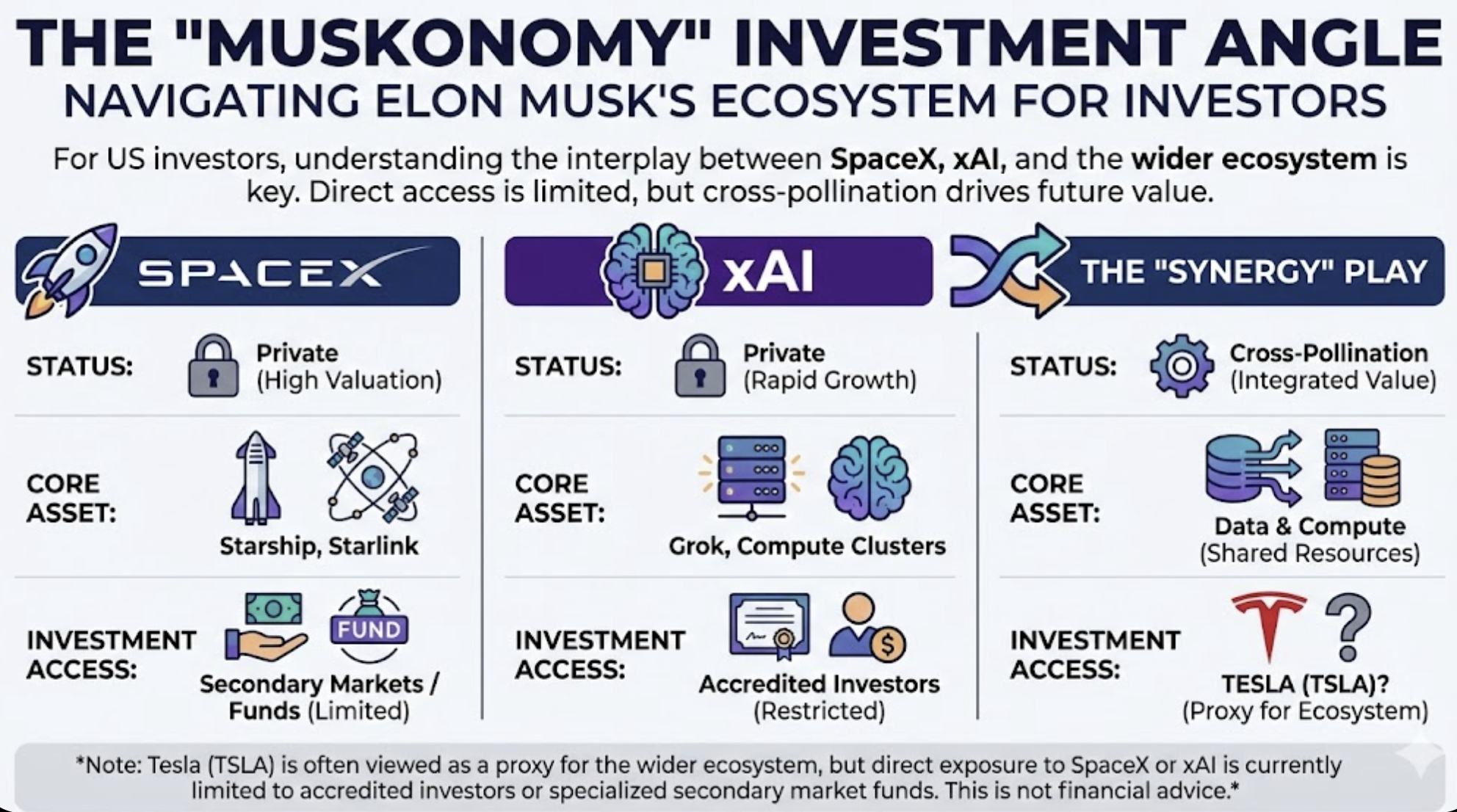
For US investors, the relationship between these companies is a hot topic.
| Feature | SpaceX | xAI | The "Synergy" Play |
|---|---|---|---|
| Status | Private (High Valuation) | Private (Rapid Growth) | Cross-Pollination |
| Core Asset | Starship, Starlink | Grok, Compute Clusters | Data & Compute |
| Investment Access | Secondary Markets / Funds | Accredited Investors | Tesla (TSLA)? |
Note: Often, Tesla (TSLA) stock is viewed as a proxy for the wider ecosystem, but direct exposure to SpaceX or xAI is currently limited to accredited investors or secondary market funds.
The "Super-App" of Tech?
Some speculate a future holding company structure (often rumored as "X Holdings") that could bring these entities under one umbrella. If xAI provides the software layer for Tesla's Optimus, SpaceX's Starships, and Neuralink's chips, the value of the shared underlying models skyrockets.
Conclusion: A Prudent Outlook for 2026
The "SpaceX xAI" narrative is not just hype; it is a logical step in vertical integration. As we move through 2026, watch for:
- Official Partnerships: Any announcements regarding Starlink using Grok.
- IPO News: Rumors of a Starlink spin-off IPO remain a key market driver.
- Regulatory Filings: Government contracts that mention both connectivity (SpaceX) and compute (xAI).
For now, the two remain distinct companies with a shared visionary leader. The convergence is happening, but it is likely to be technical and operational before it becomes structural.
FAQ: Frequently Asked Questions
Q1. Are SpaceX and xAI the same company?
No. They are separate private companies. However, they share the same CEO (Elon Musk) and likely share technical resources, talent, and data infrastructure where legally permissible.
Q2. Can I buy stock in SpaceX or xAI?
As of early 2026, both remain private companies. You cannot buy their ticker symbols on public exchanges like the NYSE or NASDAQ. Retail investors typically gain exposure through late-stage venture funds or secondary market platforms, provided they meet accreditation requirements.
Q3. Will SpaceX use xAI's Grok?
It is highly probable. Engineers at SpaceX could use Grok for coding assistance, material science simulations, and complex problem-solving, similar to how software companies use Copilot tools.
[Disclaimer]
This blog post is for informational and educational purposes only. It does not constitute financial advice, investment recommendations, or an offer to buy or sell any securities. SpaceX and xAI are private companies; investment involves high risk, including illiquidity and loss of principal. All scenarios regarding future partnerships are speculative. Please conduct your own due diligence and consult with a certified financial advisor before making investment decisions.
'주식 경제' 카테고리의 다른 글
| 에이피알(APR) 2026년 전망: 매출 2조 클럽 가입과 주가 30만 원 돌파 가능성은? (0) | 2026.02.04 |
|---|---|
| SpaceX와 xAI: ‘SpaceX xAI’가 뜨는 이유와 현실 체크리스트 (0) | 2026.02.03 |
| 주식 분석: AI 대장주의 2026년 주가 전망과 투자 전략 (0) | 2026.02.03 |
| 국장 떠나는 국민연금? 2026년 급변한 투자 비중과 대응 전략 (0) | 2026.02.03 |
| 100만 원 소자본 창업: 직장인도 가능한 현실적인 아이템 BEST 5 (2026) (0) | 2026.02.02 |


댓글